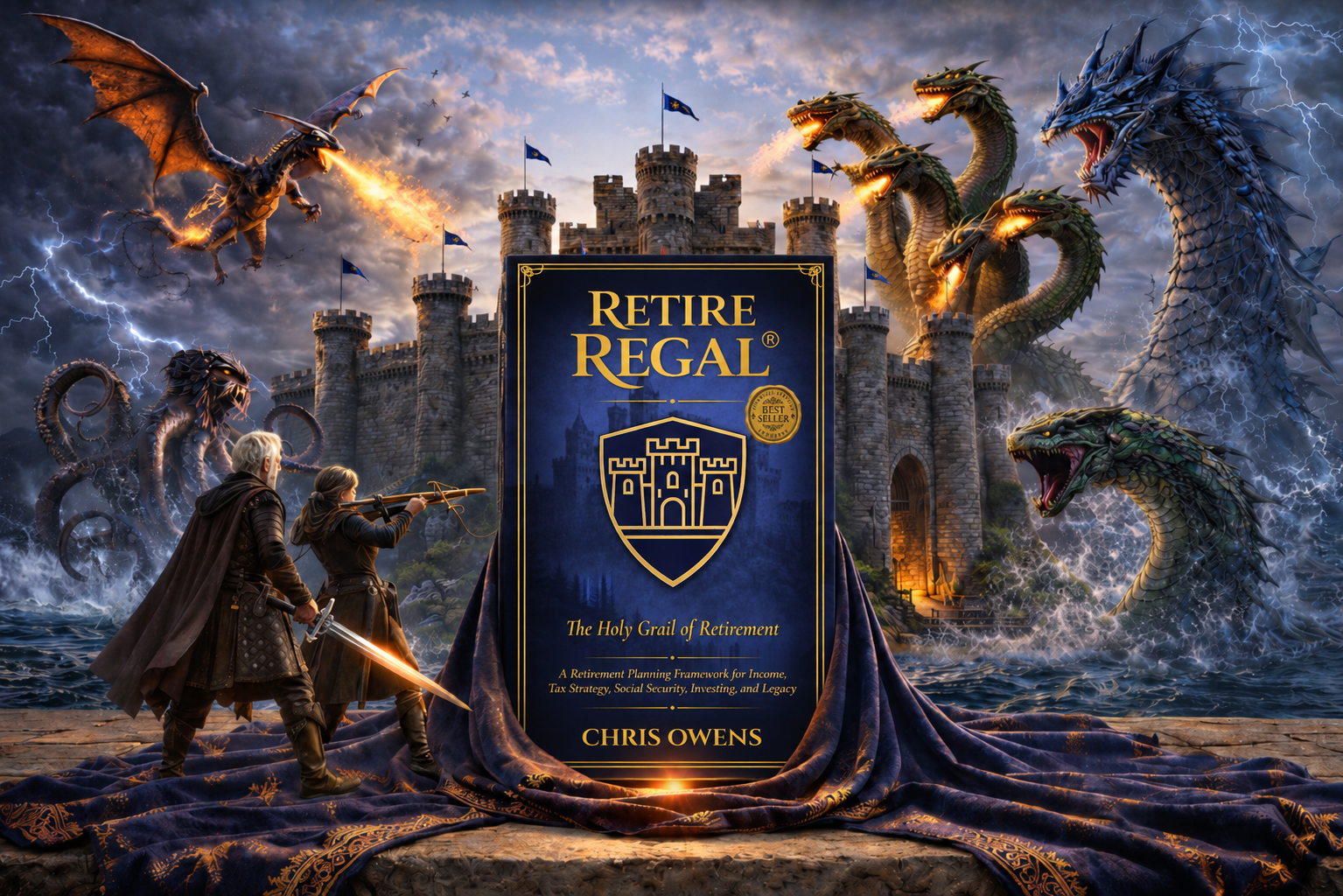
The ideas in Retire REGAL®: The Holy Grail of Retirement were built to be applied, not admired. The Armory is where you apply them — the Five Realms turned into worksheets and calculators that run on your numbers instead of illustrations. Registered readers receive access by providing the information and consent below together with the book access code.
The ArmoryThe Companion Workbook to Retire REGAL®
Welcome to The Armory
The Companion Workbook to Retire REGAL®: The Holy Grail of Retirement
Stop. Analyze the problem. Take corrective measures.
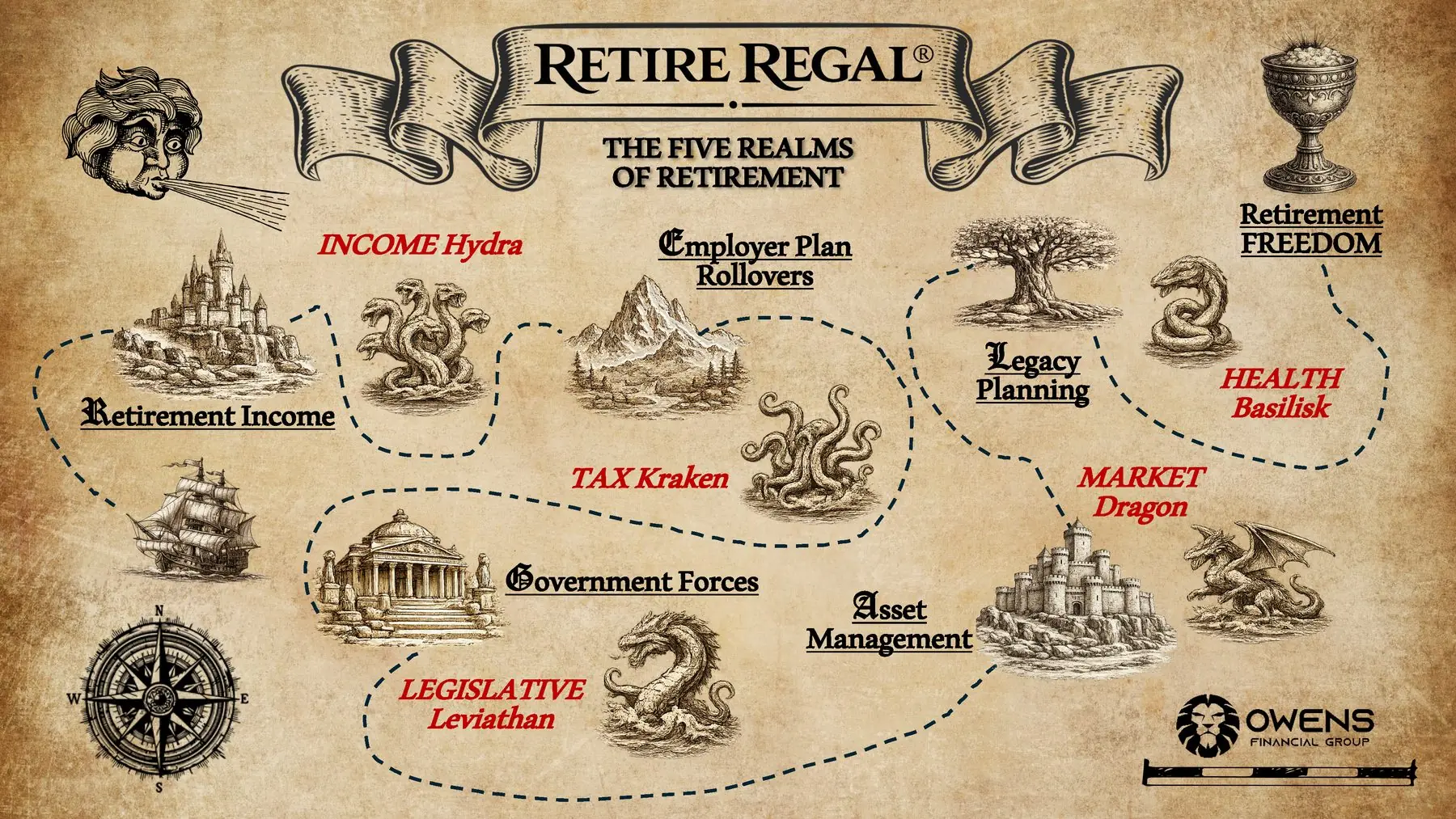
Reading the map. Read it the way a road-trip map is read: all of it once, before the first mile. Find the ship in the lower left. That ship is you, arriving from your working years. The dotted line is the route. It climbs first to the castle above the falls — Retirement Income, where the Income Hydra waits. It crosses to the mountain of Employer Plan Rollovers, with the Tax Kraken coiled just beyond. It bends back to the columns of Government Forces, where the Legislative Leviathan rises from the water below. It sweeps east to the fortress of Asset Management, with the Market Dragon resting beside its Walls. Then it climbs to the great tree of Legacy Planning, where the Health Basilisk lies across the last stretch of road before the Grail, marked FREEDOM. The face in the upper corner is the wind — the same wind that held a raven in place over a Nevada highway. The compass in the lower corner is the advice in a single image: Stop. Analyze the problem. Take corrective measures.
You chose to Stop the moment you decided to take a closer look at where your retirement actually stands — by reading the book, sitting in on a seminar, or simply choosing to engage.
Analyze the problem is what you're about to do here: gathering your numbers, mapping your realms, and naming your active Foemen — so the conversation that follows is grounded in what's actually true about your situation.
Take corrective measures is scheduling your Retire REGAL® Review, where the analysis becomes a set of priorities — what to evaluate first, and what is still missing.
Pause and Reflect: Name Your Grail
Chapter One
The Grail on the map is marked with one word: Freedom. Its meaning will differ from one reader to the next, so before studying the route, give that destination a name you would recognize in daily life.
Write down three things you hope retirement will allow you to do. Make them specific enough that another person could understand what you mean. Wanting to travel is a wish. A month near your grandchildren every summer is a destination.
Then add one responsibility you want your planning to honor — your spouse, a parent, your children, a cause, or your own future care.
If you are planning as a couple, answer separately before you compare. You may agree on the broad goal while picturing different daily lives. Keep these answers nearby — they are what the rest of the Armory is for, and they return on the last page.
The Siege — the Five Foemen converge
It would be easier if the Five Foemen wandered the terrain as isolated threats. They arrive together. They coordinate. A retiree who sees five separate problems, each requiring its own solution, is facing a Siege.
No single tactic addresses it. No product neutralizes it. What addresses the Siege is structure — and the Armory is built to help you organize that structure: realm by realm, decision by decision, in the same vocabulary used in the book.
Choose a short path, explore one concern, or use the Five Realms as your full workbook. Unfinished pages are welcome. Each section has live calculators that update in real time as you type your numbers — no spreadsheets needed. Your workbook entries are automatically saved in this browser so your work survives a refresh. They are not included in the registration submission by this page. Anyone using this browser may be able to view them, so avoid shared or public devices and use “Clear all Armory data” when finished.
1
Enter your numbers — once
Each realm has live calculators and worksheets. Matching entries, such as your current age, birth year, and the Twenty Minutes totals, stay linked. Amounts with different account scope or valuation dates are entered separately; an unchosen Social Security estimate is not assumed to be your annual benefit. Carried-over fields are tinted gold with a note saying where the number came from, and you can change any of them in place.
2
Read the case studies
Paul, Tom and Ellen, Michael and Karen, Ray and Carol, Mark and David — the stories from Retire REGAL® that illustrate each concept, with reflection questions pointed at your situation.
3
See your REGAL Stronghold™
At the end, everything assembles into your own REGAL Stronghold™ map, the book’s closing checklist (Your Map, Marked), and a booking link for your Review.
You are here
R
Retirement Income
Weakening the Income Hydra
“The Income Hydra waits at the gates. The Foundation is laid here: income to carry your essential expenses.”
The Three Layers of Income
In retirement, what you live on is not the balance on a statement. It is the income arriving in your bank account, on the dates you need it, in the amounts you need.
“Assets create potential. Income creates permission.”
Foundation Income — License to Spend
Social Security, pensions, and contractually defined income — a guaranteed income rider attached to a fixed index annuity is one tool sometimes used to expand the base. Covers essential expenses, and does not depend on whether markets cooperate. Built for stability, not growth.
Durable Income — The Walls
Dividend-paying equities, income-focused funds, laddered bonds, investment-grade fixed income, rental real estate, and income-oriented structured notes, whose payments rest on the issuing bank. These assets still fluctuate in value — what separates them from the Battlement is that they pay you while they fluctuate, which is what lets you wait out a decline instead of selling into one. Buffered ETFs cushion a decline instead of paying; they belong in the Walls of the REGAL Stronghold™ Builder, not among the income sources. Resilience, not immunity.
Tax-Free Income — The Power Above the Walls
Qualified Roth withdrawals and properly structured policy loans. They can support everyday living, and in some households they do; their distinctive value is revealed under pressure, and it is spent if the account is drawn on by reflex rather than by choice. One distinction matters — tax-exempt municipal interest still counts toward Social Security taxation and IRMAA; qualified Roth distributions do not.
Foundation, Walls, and tax-free flexibility — so that when markets drop, more of the changes you make are yours to choose.
Calculator: Your Foundation Number™
Live math
The license to spend is not something an advisor grants. It is something the structure creates — and it can be made concrete with a single calculation. Use income after taxes, set against expenses that do not count those taxes again. The calculation is useful when it reflects your household as it is, not an optimistic version of it.
The non-negotiable costs of daily life: housing, utilities, insurance, groceries, healthcare premiums, transportation — and the bills that arrive only occasionally.
Social Security, pension, annuity income, interest from treasuries or CDs — any source that does not depend on what the market did last week.
$—
Foundation Number™Enter your essential expenses and your dependable income
From the book — Paul, Chapters Seven to TenPaul’s essential spending averaged $5,000 a month. Social Security and his pension provided $4,400, and neither depended on the markets. That left $600 a month — $7,200 a year — that his savings had to supply. For the first time, his concern had a size. “Can I afford retirement?” is an enormous question. “How will I cover this $600 each month, and what else must my savings support?” is one he could examine.
If there is a gap — if essential expenses exceed dependable income — treat it as a design question, not a crisis. It means the Foundation layer of the Stronghold has room to grow. Even a surplus is a starting point: repairs, future care, rising costs, and a long retirement still need their own answers.
Worksheet: Social Security Timing — Your Three Numbers
Live math
Visit ssa.gov/myaccount and record your estimated monthly benefit at 62, full retirement age, and 70. Set expected future earnings to match when you plan to stop working. These figures inform a timing discussion; they do not select a claiming strategy. Compare the highest estimate with essential monthly spending; for a couple, record both estimates. Already claiming? Use the actual current benefit and mark the other estimates n/a. The statement’s figures are before income taxes, and so is this comparison; the Foundation Number™ above is the after-tax one.
+0%
Benefit increase: 62 → 70Delaying from your earliest to latest claiming age
Check these figures. Your age-70 benefit is lower than your age-62 benefit, which is the reverse of how claiming works. The two may have been entered in the wrong boxes.
—%
Essentials covered by Social Security alone (before income taxes)Enter your three numbers here and your essential monthly expenses above
When one spouse dies, the survivor does not keep both benefits; the household keeps the larger one. The credits a worker earns by delaying carry into the survivor benefit. Potential survivor-benefit base only; actual survivor benefits depend on SSA rules, claiming ages, and benefit history.
At this drawbridge — the Social Security Drawbridge
Can you cross back? A claim can be withdrawn once within twelve months of entitlement if every dollar is repaid; from full retirement age until 70, voluntary suspension can earn delayed credits without undoing an early claim.
What does this crossing change downstream? Taxable income, the survivor benefit, and how much the portfolio must supply.
What must be true before you step onto it? You know your three numbers, and which benefit the survivor will keep.
From the bookMark and David — Social Security Timing
Mark received a large deferred compensation payout the year he retired. Had he claimed Social Security that same year, the payout would have increased provisional income immediately, causing up to 85 percent of his benefit to become taxable in its first year. Instead, he delayed claiming. When he later claimed in a lower-income environment, a smaller portion of his benefit was taxable. The rules were the same. Only the timing differed. David claimed earlier — not to lock in favorable treatment of the benefit, which is impossible, since the taxable portion is recalculated every year on that year’s income — but to reduce what he had to withdraw from other accounts while he did his Roth conversions. He understood the tradeoff: a permanently smaller monthly benefit. Mark delayed to avoid stacking income. David claimed early to fund a bridge he would otherwise have taken from his IRA. Both decisions were correct — because both were coordinated.
No single claiming age is best for everyone. What a household can get right is the sequence. Social Security timing is a structural decision that ripples through taxation, Medicare premiums, and survivor benefits for decades — the right answer depends on your other income sources and your specific Foemen.
Apply it — your situation
Your DIY Action Steps
1
Create your free my Social Security account
Takes 10–15 min. Download your full SS statement immediately once created.
Your benefit is calculated from your 35 highest earning years. Missing years or incorrect amounts directly reduce your benefit. Call 1-800-772-1213 to dispute any error.
3
Search for lost retirement accounts
Start with DOL's Retirement Savings Lost and Found Database for private-sector employer and union plans; it does not locate IRAs, government plans, religious-organization plans, or Social Security benefits. Ask EBSA can help if you need assistance locating a plan administrator.
Claiming before full retirement age while still working: earnings above an annual limit cause benefits to be withheld under the retirement earnings test. Benefits withheld are not lost — the monthly amount is recalculated upward later — but the test can make an early claim deliver far less than expected during the working years, and the later recalculation does not fund those years.
You are here
E
Employer Plan Rollovers
The Tax Kraken Waits on the Far Side
“Employer Plan Rollovers, the mountain crossing. The Tax Kraken waits on the far side. The drawbridge ahead is the rollover itself.”
From the bookTom and Ellen — A Familiar Story
Years before the fall described in Chapter Eleven, Tom retired at 63 after nearly forty years with the same company. He and Ellen had talked about this season for years — visiting the grandkids more often, finishing the house projects, maybe finally taking that trip to Italy. His 401(k) balance was substantial, the investments familiar. When the paperwork arrived, he rolled the account into an IRA, kept the same allocation, and moved on. For a time, everything felt fine. Then a market decline arrived just as they were ready to start living the retirement they had imagined. The Italy trip was postponed. The kitchen renovation was shelved. Each withdrawal felt heavier. Each headline felt louder. Tom had the resources. What he had never done was evaluate the structure for the life he and Ellen actually wanted to live inside it.
Most rollovers are treated as housekeeping: the account is moved, the investments stay familiar, taxes are avoided. From the outside, nothing appears to change. But inside the Stronghold, everything does — assets that once existed only to grow are now expected to generate income, absorb market stress, coordinate with taxes, and support freedom over decades. Momentum builds Walls well. It does not automatically prepare them for occupancy. That evaluation came next for Tom and Ellen, and it is why a Stronghold was standing when Tom fell.
Apply it — your situation
Worksheet: Four Doors, Not One
Write it down
When you leave an employer, the balance in that plan has four possible destinations, and a rollover to an IRA is only one of them. Each deserves comparison on the same terms: what it costs, what it offers, and what it protects. Leaving the money where it is can be a deliberate choice. Doing nothing means moving it without asking any of these questions.
Door 1
Leave it in the former employer’s plan
If the plan permits.
Door 2
Move it to a new employer’s plan
If that plan accepts transfers.
Door 3
Roll it to an IRA
Often right — for consolidation, investment breadth, coordinated withdrawal design — but chosen, not assumed.
Door 4
Take a distribution and pay the tax
The Kraken’s first reach.
For each test, note which door wins for you and why. Not every test applies to every household.
Cost
Large plans often reach institutional pricing a retail IRA cannot match, and some employers absorb recordkeeping expenses an IRA holder would pay directly. Run the fee calculator below.
Access before 59½
Someone who separates from service during or after the year they reach age 55 may take penalty-free distributions from that employer’s plan. Roll the same money to an IRA and that exception disappears until 59½.
Employer stock
Company shares held inside the plan may qualify for net unrealized appreciation treatment, taxing the growth at long-term capital gains rates rather than ordinary income. A rollover to an IRA forfeits that permanently.
Protection
Employer plans carry broad federal anti-alienation protection against creditors, subject to limited exceptions such as a QDRO or a federal tax levy. An IRA’s protection outside bankruptcy depends on state law and varies widely.
Future flexibility
A pre-tax IRA balance changes the arithmetic of later Roth conversions through the pro-rata rule, which can close a door that was previously open.
Continued deferral
If the plan permits, a still-working participant who is not a 5% owner may generally delay required distributions from the current employer’s plan until retirement. An IRA offers no such exception.
More choices
An IRA usually offers a wider menu, and that sounds attractive. The useful question is which additional choices would help you do something the current plan cannot. A larger menu may be useful, or it may simply be larger.
Loose ends
An outstanding plan loan, after-tax contributions, and money of more than one tax type inside the account each have their own treatment. Find out which apply to you before choosing a door that changes them.
Two habits that make the comparison stronger
And there is usually more time than it feels like. An approaching retirement date can make everything seem urgent, but the real deadlines come from the plan and the rules that apply to it. Confirm them rather than assuming every dollar must move the day you leave.
Calculator: Annual Fee Impact
Live math
For participant-directed plans such as many 401(k)s, request the plan and investment fee disclosures required under ERISA §404a-5. Look up fund expense ratios at morningstar.com.
Plan admin + fund expense ratios combined
$—
Annual costEnter your balance and fee rate above
Note: Fee comparison alone doesn't capture the full value of advisory services. Comprehensive planning, tax coordination, and behavioral guidance may justify higher fees for some retirees. Use this calculator to surface the fee question — not to answer it.
Crossing Carefully
Once a door is chosen, the mechanics matter. A direct rollover moves the money from the plan to the receiving account without it ever being paid to you, and eligible pre-tax money generally stays tax-deferred. If the distribution is paid to you instead, the plan must generally withhold 20 percent for federal income tax, and a 60-day deadline begins. Completing a full rollover then means replacing the withheld amount from other resources. On the map, the Tax Kraken waits just beyond this mountain. This is its first reach.
Moving pre-tax money into a Roth account is a different transaction with a tax bill of its own. It should never be treated as the same paperwork. Before the request goes in, confirm how the money will be sent, which account will receive it, and what records to keep. If the plan holds more than one kind of money, make sure each has its own instruction.
At this drawbridge — the Rollover Drawbridge
Can you cross back? Rarely. Money rolled to an IRA cannot always return to an employer plan, and the age-55 exception and the treatment of employer stock do not travel with it.
What does this crossing change downstream? Income design, later Roth conversions, and creditor protection.
What must be true before you step onto it? You have compared all four doors in writing.
Beyond the Crossing — Five Checks
A rollover is finished when the arrangements are working, not when the balance appears in the new account. Five checks belong to the first weeks.
Once those arrangements are in place, there is no need to keep rearranging them simply because the new account offers more choices. A wider menu helped you weigh the rollover. It does not create an obligation to use every option.
Drawbridge Moments
During the accumulation years, most financial decisions are recoverable. Retirement changes this. The decisions that are difficult or costly to reverse arrive close together, each with a deadline of its own — a plan’s election date, a Medicare window, the year a required distribution begins. Each is a drawbridge. It lowers once. The traveler crosses. And it rises behind them. Some stay raised for good. Others can be lowered again, at a price. None should be crossed casually — and each crossing reshapes the terrain for every crossing that follows.
Some crossings have a fixed deadline — a birthday, the end of employer coverage, a plan’s election date, the end of a tax year. Others allow time to compare. Confirm which is which before treating every choice as urgent.
At every drawbridge in this book, the same three questions
Can you cross back?
What does this crossing change downstream?
What must be true before you step onto it?
Which crossings are still ahead of you?
Your DIY Action Steps
1
Search for lost employer-plan benefits
Use DOL's Retirement Savings Lost and Found Database for private-sector employer and union plans. It does not locate IRAs, government plans, religious-organization plans, or Social Security benefits.
For participant-directed individual-account plans, plan administrators must provide plan and investment fee disclosures. Contact HR or the plan administrator in writing.
The Legislative Leviathan Moves Beneath the Rules — and the Tax Kraken Reaches Through Them
“Government Forces. The Legislative Leviathan moves beneath the rules. Three drawbridges stand ahead.”
Three Drawbridges Stand Ahead
Up to this point, the focus has been on decisions you control. But retirement operates inside rules written by someone else. Taxes, Social Security, and healthcare each carry their own timing pressures, eligibility thresholds, and hidden interactions. A Roth conversion that reduces future taxes can raise Medicare premiums two years later. A Social Security claiming decision that maximizes income can trigger unexpected tax consequences. Planning that treats them separately often creates the very problems it was trying to avoid.
1
The Roth Conversion Drawbridge
Chapter Fifteen — the conversion window calculator below.
2
The Social Security Drawbridge
Chapter Sixteen — your three numbers run against your essentials in R — Retirement Income; the provisional income indicator below shows which federal income thresholds may apply to the benefit.
3
The Medicare Drawbridge
Chapter Seventeen — your enrollment dates worksheet below.
From the bookRay and Carol — The Five-Year Rule
Ray and Carol both contributed to Roth 401(k)s for years, and both retired at 65. Ray opened a Roth IRA at 55 with a modest contribution — just enough to start the clock. Carol opened hers the day she rolled her plan over. Because both were past 59½ and well beyond five years in their plans, their distributions were qualified: every dollar rolled over, contributions and accumulated growth alike, became basis in the receiving Roth IRA and was available tax-free at any time. The difference was what came next. Ray’s IRA clock had run ten years, so growth inside his account was tax-free from the start. Carol’s clock began the year she opened hers. When her husband’s medical costs arrived eighteen months later, she could draw on everything she had rolled in without tax. What she could not yet touch cleanly was the growth accumulated since. In her case the gap was small. In a longer retirement, or a more volatile one, it might not have been.
Carol did not make a mistake — but a Roth IRA opened ten years earlier, even with a token deposit, would have closed the question entirely. Both had Roth accounts. Only one had a clock that had already run. If you have a Roth 401(k) and have not yet opened a Roth IRA, first funding one starts the Roth IRA qualified-distribution five-tax-year clock. Roth IRAs have two five-year rules, including a separate rule for each conversion, so coordinate withdrawals with your tax professional before relying on tax-free access.
Apply it — your situation
The Legislative Leviathan in Plain View
Reference
The Tax Kraken and the Leviathan are easy to confuse. The Kraken is what today’s rules cost you. The Leviathan is the rules themselves changing. One asks what a withdrawal will cost. The other asks whether the assumptions behind your withdrawal plan still apply. Unlike market volatility, legislative changes do not reverse with time.
Required minimum distributions
Congress has moved the starting age twice since 2019 — from 70½ to 72, then to 73, with 75 scheduled for those born in 1960 or later. A withdrawal schedule built on the old age can need revision even when nothing about the retiree’s goals has changed. The RMD projection below uses your birth year for exactly this reason.
70½ → 72 → 73 → 75
Social Security
Nothing about your earnings record changes, yet the ground beneath a claiming decision can shift with a single act of Congress. It did in 1983, when Congress made benefits taxable for the first time and set the full retirement age on its climb to 67. The 2026 Trustees Report projects the retirement trust fund (OASI) to be depleted in 2032, and the combined retirement and disability funds in 2034. Depletion does not mean benefits stop: continuing income would still fund roughly 78% and 83% of scheduled benefits respectively, absent legislative change.
2032 / 2034
The structural answer
No one can predict legislation. A retirement plan can still be built to adapt. Diversified account types, flexible income timing, and coordinated strategies reduce dependence on a single version of the rules. The Leviathan is most disruptive when retirees lack options.
Options
Calculator: Tax Diversification
Live math
The Kraken thrives on concentration. It is weakened by diversifying across tax treatments, not just asset classes. If the tax-deferred number exceeds 70 percent, the chapters on the Tax Kraken are especially relevant. That is a signal, not a crisis. Matching fields on the Twenty Minutes page share these totals. The RMD, heir, and net-worth worksheets need their own entries because account types, eligible balances, and valuation dates can differ.
—%
Tax-Deferred PercentageEnter your account balances above
Calculator: Provisional Income Threshold Indicator
Live math
Social Security taxation is recalculated every year on that year’s income — no look-back, no smoothing. It is governed by provisional income: adjusted gross income other than Social Security (including capital gains and qualified dividends), plus tax-exempt interest, plus half of Social Security benefits. Verify with your tax transcript and IRS Publication 915.
Includes IRA withdrawals, pensions, wages, capital gains and qualified dividends
Municipal bond interest counts here even though it is not taxed
$—
Provisional IncomeEnter your numbers above
One phrase causes needless alarm. “Up to 85 percent of benefits may be taxable” means that as much as 85 percent of the benefit can be counted as taxable income. It does not mean benefits are taxed at an 85 percent rate.
Calculator: Future RMD Milestone Projection
Live math
When required minimum distributions begin, the Kraken starts feeding itself. Distributions are no longer voluntary; the IRS determines the schedule. This projection shows the size of that schedule on your balance.
Use a traditional owner IRA or plan subject to lifetime RMDs. Exclude Roth owner accounts, inherited accounts, and nonqualified annuities. Enter this account’s prior-December-31 value, not an automatically copied current savings total.
Age
Opening Balance
IRS Period
Estimated RMD
Enter a starting balance, current age, and birth year to see projected RMD milestones.
Illustration only; amounts are rounded to whole dollars. Confirm the exact required withdrawal with the custodian. Uses the IRS Uniform Lifetime Table, assumes each year’s RMD is taken near the beginning of the year, and then applies 5% growth to the remaining balance. Growing today’s balance to RMD age without withdrawals or conversions is a baseline, not an estimate of what you will actually have; if you expect to use or convert money before then, bring those amounts to the Review. A different IRS table may apply when the sole beneficiary is a spouse more than ten years younger. RMDs generally must be calculated separately for each account; IRA aggregation and employer-plan rules differ. A still-working participant may generally delay distributions from a current employer’s plan only if the plan permits it and the participant is not a 5% owner. Where charitable intent already exists, a qualified charitable distribution (available from age 70½, up to $111,000 per person in 2026) can satisfy all or part of an RMD while staying out of taxable income — and can count toward the RMD not already satisfied by other distributions. A later QCD does not undo an earlier taxable withdrawal.
Calculator: Roth Conversion Window
Live math
There is often a window — sometimes only a few years wide — during which taxable income drops significantly. The salary is gone. Social Security may not have started. Required minimum distributions have not yet begun. This window frequently represents the lowest tax bracket a retiree will see for the rest of their life, and it narrows.
— yrs
Potential Conversion WindowEnter your retirement age, current age, and birth year above
Four details sharpen the picture. A conversion cannot be undone once it is made. Each year’s required distribution must be taken first and cannot itself be converted. Where the money to pay the tax comes from changes the result. And the first year of retirement can mislead: a final salary, bonus, or severance may keep income higher than expected. Use the Tax Kraken Threat Assessment™ to see where your own exposure sits: retireregal.com/tax-kraken
At this drawbridge — the Roth Conversion Drawbridge
Can you cross back? No. A conversion made today cannot be reversed.
What does this crossing change downstream? This year’s bracket, the taxation of Social Security, and Medicare premiums two years out.
What must be true before you step onto it? You know which bracket you are filling and where the tax will come from.
Reference: 2026 Federal Ordinary Income Tax Brackets — Taxable Income
Rate
Married Filing Jointly
Single
10%
$0 – $24,800
$0 – $12,400
12%
$24,801 – $100,800
$12,401 – $50,400
22%
$100,801 – $211,400
$50,401 – $105,700
24%
$211,401 – $403,550
$105,701 – $201,775
32%
$403,551 – $512,450
$201,776 – $256,225
35%
$512,451 – $768,700
$256,226 – $640,600
37%
Over $768,700
Over $640,600
Brackets apply to taxable income after deductions, not gross income or AGI. State tax, capital gains, NIIT, credits, phaseouts, and Medicare IRMAA are not reflected here.
2026 standard deduction: MFJ $32,200; Single/MFS $16,100; Head of Household $24,150. Age 65 or over (or blindness) adds to it when the standard deduction is taken: $1,650 per person married or surviving spouse, $2,050 single — $3,300 for a couple both over 65. Additional temporary senior deduction for 2025–2028: up to $6,000 per qualifying individual age 65+, with or without itemizing, subject to MAGI phaseouts. Source: IRS Rev. Proc. 2025-32 (October 9, 2025), reviewed October 28, 2026. This is a dated 2026 reference, not a future-year tax schedule. Verify current figures at irs.gov.
Reference: 2026 Medicare Part B Premiums & IRMAA
IRMAA uses modified adjusted gross income from two years prior. A 2026 Medicare premium is generally based on 2024 MAGI unless a qualifying life-changing event applies.
Single MAGI
MFJ MAGI
Part B Monthly Premium
≤ $109,000
≤ $218,000
$202.90
$109,001 – $137,000
$218,001 – $274,000
$284.10
$137,001 – $171,000
$274,001 – $342,000
$405.80
$171,001 – $205,000
$342,001 – $410,000
$527.50
$205,001 – $499,999
$410,001 – $749,999
$649.20
≥ $500,000
≥ $750,000
$689.90
2026 Part B standard premium: $202.90/month. Part B annual deductible: $283. Source: CMS 2026 Medicare Parts A & B premiums and deductibles (November 14, 2025), verified October 11, 2026; 2027 premiums and IRMAA tiers are typically announced in November. These are federal Medicare figures and do not include state-specific, Part D, or supplemental coverage costs.
Special rule: married individuals who file separately and lived with their spouse at any time during the tax year use separate IRMAA thresholds. Verify directly with Medicare/CMS before planning around a threshold.
Worksheet: The Medicare Drawbridge — Your Dates
Live dates
Medicare is better understood as infrastructure than as enrollment paperwork. Once entered, it shapes options for years. Enrollment timing carries its own trap: coverage through current employment can let you postpone Part B without penalty, and an eight-month window opens when that work or coverage ends, whichever comes first. COBRA and retiree coverage do not extend it. Delaying Social Security does not delay Medicare, either — eligibility still begins at 65.
Whichever comes first
Confirm the effective date with Medicare. A blank Part B date leaves Medigap and premium-year estimates unknown.
Enter your birth month and year for the Initial Enrollment Period. Add a planned or actual Part B effective date for the Medigap window and premium-year look-back.
Prescription coverage: since 2025, out-of-pocket spending on covered Part D drugs has been capped for the year — $2,100 in 2026 and $2,400 in 2027, indexed each year. Part D plans change annually; formularies shift and medications move between tiers, so the annual review still matters. Medigap: benefits are standardized by plan letter in most states (Massachusetts, Minnesota, and Wisconsin standardize their own way); what differs is pricing, and two identical policies can be priced very differently. Medicare generally excludes custodial-only care; the gap between Medicare and Medicaid is where most families find themselves. Illustration only — verify your dates at medicare.gov and ssa.gov; use the first-day birthday checkbox when applicable. Disability, ESRD, and other eligibility routes may follow rules outside this worksheet.
At this drawbridge — the Medicare Drawbridge
Can you cross back? Partly. Plans can be changed each year, but a Part B late penalty usually lasts for life, and the Medigap window opens once.
What does this crossing change downstream? Premiums tied to income two years back, and the reserves that care may call on.
What must be true before you step onto it? You know your enrollment dates before employer coverage ends.
Not endorsed by or affiliated with the Social Security Administration, any federal Medicare program, or any U.S. government agency. If applicable, we do not offer every plan available in your area. Any information we provide is limited to those plans we do offer in your area.
Run Your Numbers — Tax Kraken Threat Assessment™
Live tool
The Kraken reaches five ways — pushing you into higher brackets, taxing your Social Security through provisional income, adding IRMAA surcharges, forcing distributions whether you need them or not, and handing your heirs the deferred bill. The Tax Kraken Threat Assessment™ runs your numbers (IRA balance, age, birth year, filing status, state, Social Security, other income, heirs) against current 2026 federal tax brackets, Medicare surcharge thresholds, and IRS life-expectancy tables, and illustrates how your lifetime tax exposure could change under different assumptions.
The Roth conversion lever is fully interactive — experiment with conversion amounts and conversion windows to see how your projected exposure moves. Charitable routes — qualified charitable distributions and donor-advised funds — are modeled in your Retire REGAL® Review, but only where charitable intent already exists. Giving a dollar away to avoid tax on part of it does not leave you ahead.
“Asset Management, the Stronghold. Every crossing ahead leads into it. The Market Dragon rests beside its Walls.”
Run Your Numbers — Market Dragon Timing Test™
Live tool
Two retirees can begin with identical portfolios, withdraw the same amount each year, and earn the exact same average return over a decade. If one experiences the bad years first and the other experiences them last, the difference in ending balances can be dramatic — undone by timing rather than by returns. The Market Dragon Timing Test™ takes three inputs (starting balance, year-1 withdrawal, inflation toggle) and shows you the difference between two real historical retirement decades — plus a controlled sequence-of-returns experiment using the same returns reordered.
From the bookMichael and Karen — A Tale of Two Retirees in Their 60s
At age 62, Michael and Karen—fictional retirees in two different households—retired with the same $1,200,000, the same $70,000 of annual spending, no pensions, the same plan to claim Social Security at 67, and roughly 40 percent in growth assets. On paper, they looked identical. Michael’s portfolio, however, was blended. Growth, income, and stability were mixed together, and none of it had been given an expense to cover—so in the book’s terms it was still an accumulation portfolio, whatever its percentages. When markets declined, income withdrawals continued proportionally. Each downturn forced him to sell assets he hoped to hold long term. Volatility quickly became personal. Karen’s portfolio was structured differently. Her essential expenses were covered by a bond ladder and a small income annuity until her benefit began, her Walls paid part of the rest, and her growth assets lived behind that structure, untouched during market stress. When markets declined, nothing needed to be sold. Time remained available.
Both held the same 40 percent in growth assets. Only Karen had given the other 60 percent retirement jobs. The Rule of 100 points in the right direction. The REGAL Stronghold™ determines whether the plan holds.
Apply it — your situation
Calculator: REGAL Stronghold™ Builder
Live math
The REGAL Stronghold organizes retirement assets into three functional layers, sorted by role rather than product type. Instead of asking what percentage goes where, it asks: what is each dollar responsible for when conditions are imperfect?
Growth-oriented holdings and opportunistic capital, whether in Roth or other accounts — classify the underlying investment and its job, not the account label alone
Dividend-paying equities, corporate and municipal bonds, real estate held for the income it produces; income-oriented structured notes (every payment rests on the issuing bank); buffered ETFs, which cushion a decline rather than pay income
CDs, U.S. treasuries, properly structured fixed annuities — designed to return principal when held as intended
Current asset or contract values from the statements; leave out your home, any death benefit, and the Reserve. Income is separate from asset value: Social Security and pension payments belong in the Foundation Number™, not here — do not invent a capital value for them — and an income-only annuity may pay without a remaining asset value. A small Foundation here can sit beside substantial dependable income.
—%
Battlement %
$—
Total assetsacross all three layers
The Rule of 100 — subtract your age from 100 — is a rough starting point for the share of wealth that might live in the Battlement, not a prescription. As the book uses it, the rule sizes the Battlement alone. Dividend equities in your Walls are still equities, so count them when you measure your stock-market exposure. The rule is not about becoming conservative. It is about relieving growth assets of responsibilities they were never meant to carry indefinitely.
At this drawbridge — repositioning into the Stronghold
Can you cross back? Usually, at a cost: repositioning can trigger taxes, surrender charges, or a missed recovery.
What does this crossing change downstream? Which assets answer each Foeman, and what remains for legacy.
What must be true before you step onto it? Every dollar has a job before any dollar moves.
Worksheet: Every Dollar Has a Job
Account roles
List each major account, or the holdings within it, and the job each serves. A label — Roth, IRA, taxable — does not decide the job. Split an account across rows when its holdings have different jobs; count each dollar once. Defined roles make income decisions simpler and help show what each resource can do during a decline.
Account or holding — institution, type, balanceLayerIts job
Pause and Reflect: Your Own Dragon Week
Think about an unexpected expense arriving in your own life during a market decline. Where would you look first? What would you need to know before using that resource? Which other intention would be affected? If those answers are uncertain, you have found a useful place for further work.
From the book — Paul, Chapter TenThe contractor’s estimate arrived during a week when Paul had already decided to stop watching the financial news. The repair would cost $12,000. His investments were down. He had set aside a $30,000 reserve for unexpected needs, and the repair fit the purpose assigned to that money. Using $12,000 would leave $18,000. What mattered was that he had identified a source before the expense arrived, so he did not begin by selling a depressed growth investment. He shortened the trip, deferred another purchase, and named the point at which he would look again. Now picture the same week without that preparation: he would have started with whichever account was easiest to reach, or whichever investment he most wanted to abandon after reading the news.
Worksheet: Four Doors for One Expense
Write it down
When an expense arrives, the most familiar account is not necessarily the most suitable source. Name the expense and its amount, then fill a row for each door: what it costs in tax, what it uses up, and what it leaves for emergencies. The doors are not ranked — the comparison is the point, and it is the one to run before a decline makes it urgent.
DoorTax effectWhat it uses upWhat it leaves for emergencies
Cash reserveThe first source for a surprise — not income.
Taxable accountCapital-gains tax on any gain in the shares sold; selling in a decline means selling at lower prices.
Traditional IRATo net the amount, the withdrawal is larger: the difference is federal income tax, plus any effect on how much of your Social Security is taxed.
Roth IRANone as a qualified distribution — but assets assigned to later years cannot be put back, and a Roth holding volatile investments is still exposed.
From the book — Paul, Chapter NineFor an $8,000 trip, Paul’s four doors looked like this. Cash reserve ($30,000): no tax; uses money set aside for repairs and surprises; leaves $22,000 until the reserve is rebuilt. Taxable account ($210,000): capital-gains tax on any gain in the shares sold — 0 or 15 percent for most retirees, depending on the year’s income; uses holdings that pay part of his income; leaves the reserve intact, income slightly lower. Traditional IRA ($520,000): to net $8,000, a withdrawal of about $9,100 to $10,300, the difference being federal tax at 12 to 22 percent, plus any effect on how much of his Social Security is taxed; uses money that is also where later tax decisions will be made; leaves the reserve and the taxable account intact. Roth IRA ($90,000): none, as a qualified distribution; uses assets assigned to later years, which cannot be put back; leaves the reserve intact, the most flexible account smaller. He chose the taxable account, from a holding with little gain, and the cost he wrote down beside the trip was the roughly $280 a year of income those shares had been paying.
Calculator: Net Worth Snapshot
Live math
Assets
Liabilities
$—
Assets minus liabilities. Unanswered categories remain unknown; enter 0 for none. An incomplete result is labeled provisional.
You are here
L
Legacy Planning
The Health Basilisk Lies Across the Path
“Legacy Planning. The Health Basilisk lies across the path. The drawbridge ahead is the set of documents that speak when you cannot.”
From the bookTom and Ellen — Who Holds the Map When You Cannot?
After Tom’s recovery, he and Ellen finally sat down with their daughter to discuss their plans. She asked a question neither had quite expected: “If something happened to both of you, who would I call first?” They had been preparing to explain their wishes. She was trying to imagine the first morning she might have to act on them. Ellen knew where the household bills were kept. Tom usually handled the conversations about their investments. Both knew their advisor, but their daughter had never met him. Until Tom’s fall, none of those details had caused trouble. Together, they showed how much of the plan depended on knowledge that had never left the two of them. So they answered her with a short guide to their household — and writing it revealed a few gaps, each easy to fix in an afternoon.
Documents create authority. Coordination preserves intention. Their daughter had a second question: did being named in the documents mean she could step in whenever help was needed? It did not. A durable financial power of attorney, healthcare documents, and an executor’s role each authorize different things at different times, and the trusted contact on file at a brokerage can be called but cannot trade, withdraw money, or learn a balance. A name on one form had not completed the handoff. This is the Health Basilisk at its quietest: it leaves the assets and takes the person who knew what to do with them.
Apply it — your situation
Calculator: SECURE Act Impact on Your Heirs
Live math
When tax-deferred accounts pass to non-spouse beneficiaries, those heirs generally inherit not just the balance but the tax liability. Under current rules, most non-spouse beneficiaries must draw the account down by the end of the tenth year following the owner’s death — and if death occurred on or after the required beginning date, a beneficiary subject to the ten-year rule generally must also take annual distributions in the intervening years. Eligible designated beneficiaries — including certain spouses, disabled or chronically ill people, minor children of the owner, and people not more than ten years younger — can have different rules. Trust and non-individual beneficiaries need separate analysis. In many cases this obligation coincides with the heir’s own peak earning years. This illustration assumes equal shares of an entirely pretax eligible account, zero growth, ten even annual distributions, and a fixed 2026 ordinary-income snapshot using only the base standard deduction. It is not an annual-RMD schedule or a future-tax forecast. Basis, Roth accounts, capital-gain rates, itemizing, senior deductions, other income adjustments, and state taxes require separate analysis.
$—
Illustrative distribution per heirevenly spread across 10 years
$—
Each heir's combined income
Beneficiary Designation Audit
Highest priority
For a large share of retirement wealth, the will and the trust are not the controlling instruments at all. IRAs, employer plans, life insurance, annuities, and transfer-on-death accounts pass according to the beneficiary form on file, subject to plan terms, spousal rights, QDROs, court orders, and applicable law. When the two disagree, the form usually wins. Log in to every account individually — do not rely on memory.
AccountPrimaryContingentCurrent?
One large exception catches people: in an employer plan governed by federal law, a married participant’s spouse is generally the beneficiary whether the form says so or not; naming anyone else requires the spouse’s written, witnessed consent. IRAs are not covered by that federal rule, though in community property states a spouse may still hold rights in what accumulated during the marriage. The discipline is unglamorous: name a primary and a contingent beneficiary on every account, review the forms whenever life changes, and confirm that what they say still matches the will and trust they are meant to support.
Beneficiary Audit
Review checklist
Beneficiary designations on IRAs, employer plans, life insurance, annuities, and TOD accounts generally control how those assets pass, subject to plan terms, spousal rights, QDROs, court orders, and applicable law. Many legacy disputes arise from forgotten or misaligned beneficiary forms.
The 2026 federal basic exclusion amount is $15 million per individual. Married couples may preserve up to $30 million of estate-and-gift-tax exclusion with proper planning and a timely portability election; prior taxable gifts and GST planning require separate analysis. For most families, coordination—not federal estate tax—is the more immediate concern.
0
Beneficiary review items flagged
By the Numbers — Federal Transfer Tax (2026)
Reference
The numbers most often misquoted in living-room estate conversations. Federal figures shown; state estate and inheritance tax laws vary widely.
Federal estate / gift / GST exemption
Per individual in 2026 under the One, Big, Beautiful Bill, indexed for inflation beginning in 2027. Married couples may preserve up to $30M of estate/gift exemption with proper planning and a timely portability election, but GST exemption is not portable and requires separate planning.
$15.0M
Annual gift tax exclusion (per recipient)
2026 figure; unchanged from 2025 and indexed periodically. Gifts at or below this amount per recipient per year generally do not consume your lifetime exemption.
$19,000
Federal estate / gift tax rate above exemption
Flat top federal rate. State-level estate tax can stack on top of this.
40%
States with their own estate or inheritance tax
Estate tax: CT, DC, HI, IL, ME, MD, MA, MN, NY, OR, RI, VT, WA. Inheritance tax: KY, MD, NE, NJ, PA. Maryland has both. State laws and exemptions change frequently.
13 / 5
Step-up in cost basis at death
Many non-retirement assets receive a basis reset to fair market value at death — heirs only owe capital gains on growth after that date. Traditional IRA and 401(k) balances do NOT get step-up, and neither do income-in-respect-of-a-decedent assets such as nonqualified deferred annuities, savings bonds, and deferred compensation, whose gain stays fully taxable as ordinary income to the beneficiary.
FMV
Figures reflect law as of October 11, 2026 (IRS Rev. Proc. 2025-32; One Big Beautiful Bill Act) and may change. Consult a qualified tax professional before acting on any specific figure.
Estate Document Status
A will is a set of instructions; it speaks only after death and works through probate. A properly designed and funded trust provides continuity — while you are alive, during incapacity, and after death. Legacy planning is as much about who can act when you cannot as about who receives assets.
At this drawbridge — the documents that speak when you cannot
Can you cross back? Mostly, while you have capacity: most documents and beneficiary forms can be changed until the day they are needed. After that, your family works with whatever is on file.
What does this crossing change downstream? Who can act, how quickly, and what the people you love must guess at.
What must be true before you step onto it? The forms, the documents, and the people named in them all tell the same story.
A Starting Point Someone Else Can Use
Household guide
Tom and Ellen answered their daughter’s first question with a short guide to their household. It was not a list of passwords — knowing a password does not establish legal authority to use an account. Fill in the outline here, keep the full version with your records, and tell the person named in your documents where it is.
They also wrote a letter — their own words about what mattered. It did not replace their legal instructions, and they took care that it did not contradict them. Ellen wanted their daughter to know that accepting paid help would not mean the family had failed them.
Practice the handoff: a few minutes of walking through the situation shows more than another stack of paperwork would. Revisit the guide whenever something meaningful changes.
Planning for Care Before Care Plans for You
The Health Basilisk tightens gradually, and the costs it introduces are among the least predictable in retirement. Medicare generally excludes custodial-only care; Medicaid becomes relevant mainly in long-term care, where eligibility turns on income, asset, and functional rules that vary by state, with spousal-impoverishment provisions protecting a portion for a spouse still at home. There is no single solution, but there are three paths worth understanding — and what matters is that the decision is made deliberately, while options remain open.
Traditional coverage requires medical qualification and premiums can increase; hybrid policies answer the “premiums for coverage never used” objection but typically require a larger upfront commitment; self-funding preserves control but concentrates the risk in assets that may need to stay liquid and conservative. Guarantees in any insurance-based strategy are subject to the claims-paying ability of the issuing company.
Legacy Intentions
Start with one distinction. You may want your children to receive whatever remains after you have lived well. Or you may want to protect a particular amount for them, even if that changes your own spending. There is a third possibility: to give some of it while you are here. Those are different commitments, and a plan should know which one it is serving.
Who are you building this for — beyond yourself?
What matters most when you're no longer here to manage it?
Where charitable intent already exists, two tools serve different seasons of the same purpose: a donor-advised fund positions a gift during a high-income year (the deduction lands where income is highest; the grants can follow later), and a qualified charitable distribution redirects income once distributions become unavoidable. Neither leaves the donor ahead — a $100,000 contribution in a 32% bracket saves no more than $32,000 in federal tax and permanently removes $100,000 from the balance sheet. For a retiree who does not intend to give money away, the plain answer is usually to pay the tax and keep the remainder.
REGAL Quest™ — Boost Your Family's Financial Literacy
REGAL Quest™, an educational experience built using the same Retire REGAL® Five Realms vocabulary. Pass-the-device, multi-generational. Designed to be played with your spouse, your adult children, or your grandchildren over Sunday dinner.
Legacy is more than documents. It is vocabulary — the language a family uses to talk about money. REGAL Quest™ builds shared family vocabulary in an environment where it sticks: the dinner table. Money itself is never a game. The wisdom to handle it well, however, is worth playing for.
The legacy you build is the one the family understands.
★
Your REGAL Stronghold™
Your Personal Retire REGAL® Map
Below is your Stronghold as entered so far — one realm or all five — with the book’s closing checklist marked for your household, the topics it surfaces for review, and your three, in order. Finished or not, it is enough to start a conversation. The map printed in the book is Chris’s. The marked one is yours.
Your Stronghold Assessment
Your Stronghold — not yet started
The Five Foemen of Retirement™ do not take turns — they arrive together. Check which are most active in your plan; they are prompts for the Review, not risk ratings or a diagnosis, and your selections sharpen the priorities below.
The Checklist: Your Map, Marked
From the book
What I Understand
Check each line once you understand how it applies to your household.
FoemenThe one that concerns us most is
and our next step is
What I Have Done
Check a line here only when the task is finished — a number written down, a form on file, a conversation had.
Your Five-Realm Stronghold
Your Stronghold synthesis will appear here once you’ve worked through the realms above.
Suggested Topics to Review
Pulled from your inputs across all five realms, in a suggested order — deadlines, consequences, and what matters most to you can change it. These are candidate topics for an educational conversation—not recommendations, and not a diagnosis of your household—and should be evaluated in the context of your complete financial, tax, legal, insurance, and family situation.
Your First Topic to Evaluate
Stop. Analyze the problem. Take corrective measures.
—
Your Stronghold Report — every figure, answer, and topic from this workbook, with a Review Brief in front — saves to your device and goes to Chris with your contact details, so the Review can start from the document you have. Nothing is sent until you request it.
Limited weekly Review blocks
When to book. If a crossing is already in motion — a rollover, a Medicare window, an RMD year — book this week. Bring your questions; unfinished pages welcome.
Your Retire REGAL® Review
Sixty minutes on Zoom, no cost, your pages as the agenda — the Foemen, the Siege, and the Stronghold applied to your situation.
The Review
Mostly me listening: your map, your Foeman, your pages — finished or not.
What you leave with
Where you stand, the topics worth evaluating first, and what is still missing — on your Review Record, completed together. You can save or print it, including unfinished questions.
How we work together
The Review is the first of three conversations, and it is mostly me listening. If you choose to continue, then I get to work: an in-depth recommendation that covers every realm of your REGAL map, presented to you alongside a year-by-year cash-flow strategy. In the second conversation I listen again — what feels right, what looks good, what doesn’t. The third is the final proposal, built from that feedback, and if something still needs to change, we change it, until the plan is understood and accepted with confidence. Before deciding, ask who your main contact would be, how your priorities and past decisions would be recorded, and how a handoff would work if someone changed. I don’t charge for any of these conversations or the proposal unless and until you choose to become a client under a written agreement, with the fees and terms disclosed before you sign.
Bring your pages — the printed workbook open to Your Map, Marked, or your Stronghold PDF. Unfinished pages welcome.
Prefer to talk first? Call 1.800.658.8156 and we’ll get you on the calendar.
You’ve stopped. You’ve analyzed the problem. Now it’s time to take corrective measures — because freedom is never found by chance. It is built by design.
Educational / Hypothetical Illustration: The Armory is provided for educational and illustrative purposes only. It is designed to help users organize questions and identify retirement-planning topics for discussion. It is not a financial plan, investment recommendation, tax projection, legal opinion, Social Security claiming recommendation, Medicare recommendation, estate-planning document, or individualized advice.
No Advisory Relationship: Use of this workbook, submission of a registration form, scheduling a Retire REGAL® Review, or receiving a proposal does not by itself create an advisory, fiduciary, tax-preparer, attorney-client, or client relationship. The Review is a complimentary educational conversation; the recommendation and cash-flow strategy described above are prepared and presented without charge or obligation, as a proposal for your consideration, and no fee is charged unless and until you choose to become a client under a written advisory agreement, whose fees and terms are disclosed before it is signed. Any recommendation or strategy should be reviewed in the context of your complete financial, tax, legal, and insurance situation.
Tax, Medicare, Social Security, and Legal Limitations: Federal tax, Medicare, and Social Security reference figures were reviewed against IRS, CMS, and SSA sources on October 28, 2026. Tax laws, Medicare premiums, IRMAA thresholds, RMD rules, Social Security rules, and estate-planning laws may change. The calculators use simplified assumptions and generally do not model state taxes, credits, deductions, capital gains rates, NIIT, Medicare Part D premiums, itemized deductions, charitable limitations, pension exclusions, state-specific treatment, beneficiary-specific exceptions, or other facts that may materially change results. Consult qualified tax and legal professionals before acting.
Calculator Heuristics: Calculator labels such as “Strong,” “Adequate,” “Moderate,” “High,” “Alert,” “Primary Focus,” or similar terms are educational heuristics only. They are not risk classifications, investment recommendations, tax advice, legal advice, insurance recommendations, or financial-planning conclusions.
Investment and Insurance Disclosure: Investment advisory services are offered through Foundations Investment Advisors, LLC ("Foundations"), an SEC registered investment adviser. Chris Owens is an Investment Adviser Representative associated with Foundations. Owens Financial Group, LLC is a separate entity. Insurance and annuities are offered through Owens Financial Group, LLC, and Chris Owens NPN #19094788. Advisory clients are not obligated to purchase insurance services from the adviser and may use any insurance brokerage firm and agent of their choice. Insurance and annuity guarantees are backed by the claims-paying ability of the issuing carrier and are subject to product terms, fees, surrender charges, limitations, and suitability requirements. Cash-value life insurance policies require ongoing maintenance and may lapse, be surrendered, or become a modified endowment contract; policy loans and withdrawals may reduce cash value and death benefit and may create taxable income if the policy is not maintained as designed. Roth distributions are subject to applicable Roth IRA and Roth account rules. Social Security and employer pension benefits depend on the continued funding and rules of the responsible government program or plan sponsor; pension benefits may be limited by PBGC coverage where applicable. Investments in securities involve the risk of loss, including a total loss of money invested. Any past performance is no guarantee of future results. Advisory services are only offered to clients or prospective clients where Foundations and its advisors are properly licensed or exempt from licensure; Foundations reserves the right to accept or reject any prospective client. For more information about us, please go to https://adviserinfo.sec.gov and search by our firm name or by our CRD #175083.
Commentary and Third-Party Content: This commentary reflects the personal opinions, viewpoints, and analyses of the author, Chris Owens. Chris Owens is registered as an Investment Adviser Representative with Foundations Investment Advisors, LLC. This material does not necessarily reflect the views of Foundations Investment Advisors, LLC (“Foundations”) and is provided for educational purposes only. The contents are solely maintained by, and are the responsibility of, the applicable third party. Third-party content is subject to change at any time without notice and does not represent an express or implied opinion or endorsement of any specific investment opportunity, investment strategy, or planning strategy. Foundations does not deem any statistical data or information obtained from or prepared by third-party sources in this commentary to be reliable, nor does Foundations guarantee its accuracy or completeness. No legal or tax advice is provided or intended.
Marketing Communication: This workbook is a public educational and marketing communication. It should not be relied upon as the sole basis for any financial, tax, investment, insurance, retirement, Social Security, Medicare, or estate-planning decision. Benefits of strategies discussed are presented with limitations and are not guaranteed.
Privacy / Lead Information: Registration information — your name, email address, and phone number if provided — is submitted to Owens Financial Group over an encrypted (HTTPS) connection on this same domain, received by our hosting provider’s form service, and may be routed onward to third-party workflow or intake systems. Your name and contact details are also kept in this browser so a report request can be prefilled. Separately, financial amounts, notes, beneficiary names, checklist responses, and other workbook entries are stored in this browser’s local storage so your work survives a refresh. Workbook entries are not included in the registration submission by this page, but anyone with access to this browser may be able to view them. Avoid shared or public devices; do not enter account numbers, Social Security numbers, passwords, login credentials, or other highly sensitive identifiers; and use “Clear all Armory data” when finished — it removes your workbook entries and your stored contact details from this device. The Stronghold Report (PDF) is provided in exchange for your contact details: when you request it and confirm your name, email address, and phone number if provided, the PDF — which contains the figures, names, and notes you entered — is transmitted with those details to Owens Financial Group over the same encrypted connection and form service, so Chris can prepare for and review the same document with you, and the same file is saved to your device. Nothing is transmitted until you request the report, and the report is not sent without the contact details you confirm. This site may also use cookies, analytics, advertising pixels, or similar technologies to understand usage and improve marketing.
Non-Affiliation: Owens Financial Group, Retire REGAL®, and this workbook are not affiliated with or endorsed by the IRS, Social Security Administration, Medicare, CMS, Department of Labor, or any government agency. If applicable, we do not offer every plan available in your area. Any information we provide is limited to those plans we do offer in your area. References to third-party sites are provided for convenience and should be verified directly with the applicable source.
Companion to the Book: The Armory is the companion workbook to Retire REGAL®: The Holy Grail of Retirement (Owens Financial Group, LLC, 2026). Case studies named here — Paul, Tom and Ellen, Michael and Karen, Ray and Carol, Mark and David — are the book’s fictional illustrations, reproduced for educational purposes. The characters in these examples are fictional only. Your actual experience will vary.
Trademarks: Retire REGAL® is a registered trademark of Owens Financial Group, LLC. REGAL Stronghold™, Tax Kraken™, Income Hydra™, Legislative Leviathan™, Market Dragon™, Health Basilisk™, REGAL Quest™, Foundation Number™, Tax Kraken Threat Assessment™, Market Dragon Timing Test™, Five Realms of Retirement™, and Five Foemen of Retirement™ are trademarks of Owens Financial Group, LLC. All rights reserved. All case studies are hypothetical/composite educational examples unless otherwise expressly stated.